


Increase Web Traffic Targeted to Your Niche
Welcome to 'Increase Web Traffic Targeted' page. Once You have "Web Traffic", it's easy to decide what to do with it.
But, the very first thing to make sure is that, your traffic is indeed targeted to your Product/Service.
To 'Build Web site Traffic' is a rather painstaking process if it's organic traffic. And if it's a paid "Web Traffic" it's expensive.
But, you only have these two choices, to 'Increase Web Traffic Targeted' to your niche or website.
A site without traffic is a site without profit...
It's all about traffic and nothing else.
---> Click here to get the password for the page...
Why Should You Read this Page to the end?
Because You are going to get my 'SEO Success Strategies' to please the engines and achieve "Guaranteed Search Engine Positioning"!
Increase Web Traffic Targeted Table of Contents:
Increase Web Traffic Targeted: Related Pages
OK. So, let's look at the 'SEO' strategies to 'Increase Web Traffic Targeted' to your website. Now, when we talk about 'Search Engine Optimization', really there are only two ways to do it.
> The On-page SEO
> The Off-page SEO
On this page, I will discuss the On-page SEO strategies, as it directly involves your 'Web Content'.
The Off-page strategies are more indirect and subtle, and will be covered on, "Build Web site Traffic with Power packed Off-page SEO Strategies" page.
Therefore keep tuned in for the updates...
>Top<
Essential SEO Reading:
> Winning Search Engine Positioning Steps!
> Get Your Guaranteed Search Engine Positioning Tips
SEO is a little bit tricky topic, and requires caution while treading that path.
You need to walk the middle path with SEO. Why?
Because, if you overdo your search engine optimization, it will lead to reverse effects...

>Top<
Increase Web Traffic Targeted with On-page SEO
As said earlier, I will go over the essential on-page strategies for good "Search Engine Positioning", that will eventually increase web traffic targeted to your niche product/service.
What You Should Know about SEO? –Free Lessons
Well, first of all, SEO is a technique by which, you make your web pages pleasing to the engines. In other words, make it readable to the engines. Generally termed as spider food.
Why you Need to Bother?
If you want your website to be found by the searchers, this is the only way it can be done.
The engines should be able to read your 'Web Content', so that, it can provide your information to the global surfers, in response to their search query.
You see how this helps immensely to Increase Web Traffic Targeted to your website!
>Top<
Google suggests that you write your web content for the visitors, and not essentially for the search engines. What does this mean?
Relevancy and usefulness of your web content!
So, are we to completely ignore the engines?
Heck no. While you should keep Google's point in mind, it is essential to learn about SEO, in order to walk the fine line of:
Writing for your visitors, while pleasing the engines!
>Top<
If you just focus on your visitors and ignore the 'Spider food', your pages will not get a good treatment from the engines..
I think you need a little bit education on SEO. In order to have some background understanding about SEO and its real purpose, head over to the following pages:
> Winning Search Engine Positioning Steps!
> Get Your Guaranteed Search Engine Positioning Tips
OK. Let's have our strategy for the on-page SEO.
>Top<
Steps to Increase Web Traffic Targeted to Your Market with On-page SEO:
1-> Increase Web Traffic Targeted with Clever Page Title:
One of the most important SEO element, is your Web page title. Why? Where will I find the page title?
Good question. On the top of your browser. E.G., when you type in "marketing-strategies-to-succeed-online.com/increase-web-traffic-targeted.html" in your browser, you will see the result as shown below...
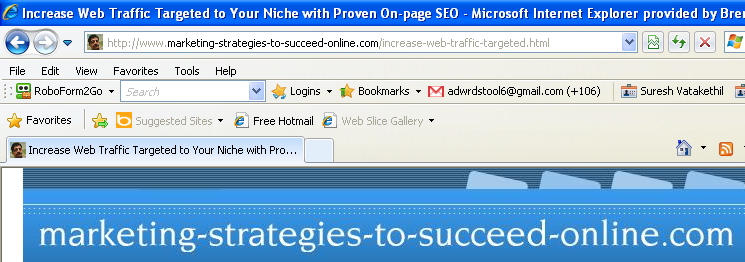
See how the title for this page 'Increase Web Traffic Targeted to Your Niche with Proven On-page SEO' reads on the very top of the browser!
Engines attach a great deal of importance to this title. The very 1st rule of SEO.
Having said that, let's look at some salient points for your page title.
>Top<
Increase Targeted Web traffic with these Tips
> Keyword: Include your main keyword in the page title. Now, if you are using a long tail keyword, ensure that, your long tail key word read sensibly on your page title.
For example, see how a long tail keyword like, 'Increase Web Traffic Targeted', fits just fine on the page's title, 'Increase Web Traffic Targeted to Your Niche with Proven On-page SEO'...
Do you get my point?
Remember, your webpage content should please BOTH visitors and the engines alike.
>Top<
--> Include your main keyword in the beginning of your page title. Spray some variations of your keyword, and try to include some broad terms. At the end, make sure your title is easy to read and conveys the message to your visitor.
--> This is also an opportunity to 'Brand' your product/service. How? Just include the name of your product/service, at the end of your page title. Make sure it reads well.
--> Never repeat your main keyword on the title, unless there is a reason to, and it should fit naturally in the flow.
Keyword stuffing at all costs should be avoided. Engines can penalize and devalue your ranking and indexing.
Follow the tips on 'Increase Web Traffic Targeted' page and you will be just fine.
>Top<
> Page Title Length: Your web page title should be ideally Less than 80 characters in length. Why?
See this image below and judge yourself, "what should be the length of your web page title?"
Your title should fit into the length of the browser, isn't it?
How will I do this? Is this what you are thinking?
Any good HTML editing software will make this a breeze..

>Top<
2-> Increase Web Traffic Targeted to Your Site with Tempting Description:
What is description? Well, you want to draw the surfer's eyeballs to your website, isn't it?
And for that, the introductory description about your web page is crucial.
Here is an example:
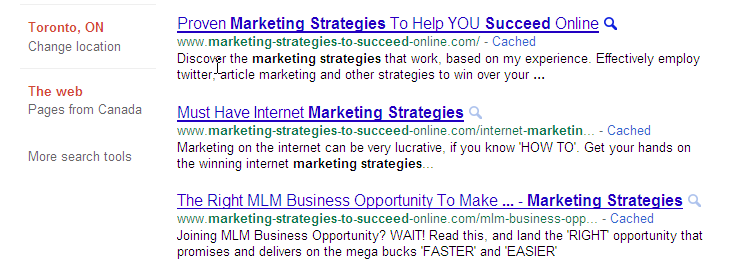
Do you see the description about "Marketing Strategies", finely written and displayed as a 'Lead-in' to the website content?
>Top<
Now, your web page must be crawled and indexed by the engines, to see your description. But, this strategy is crucial to Increase Targeted "Web Traffic", no doubt on that.
Rules to Write a Good Description?
Your Description:
a) Should contain your main keyword.
b) Should be under 200 or so characters.
c) Should not be misleading..Visitors don't like surprises, and the engines take notice of that.
d) Should be persuasive and compelling.
e) Should not repeat your same title. Include lateral and related keywords. Optimize on this precious space best way possible.
f) Should not repeat your main keyword unless it's logical and fits in the flow. Keyword stuffing is big NO..No
g) Should keep your Most Wanted Response in mind. And that is to get the visitor in.
If you follow the above rules and implement it, then you will definitely increase web traffic targeted to your product/service or website.
>Top<
3-> Increase Web Traffic Targeted to Your Site with Eye Popping Headline:
The head line is actually is what your visitor will see after he clicks on your description. Your description has already given your visitor an idea of what he/she can expect after clicking.
Don't disappoint your visitor. You will not only lose him/her, the engines will take note of the visitor action.
Google is seriously implementing this info on their search engine algorithm.
Your "Search Engine Ranking" will fall or rise increasingly, based on visitor action/reaction.
The whole point is to increase web traffic targeted to your product/service. That's how life 'Online' is.
>Top<
Tip to Increase Web Traffic Targeted
Use your page description and distribute it in half, such that, the first part will form your headline. It will contain your specific Keyword and must be about 80 characters, in total.
The other half, you will use as the introductory paragraph of your web page. Make sure that the words flow naturally and the sentences are grammatically correct. You may need to re-work the words a bit.
>Top<
Increase Web Traffic Targeted with Subtle On-page Techniques
How about Your Meta data? What the heck is that?
Your meta description is actually what your page description for your web site is, as discussed above.
But here, it is presented to the search engines, using the meta tags. These are not visible to your visitor, unless they look for it, in the HTML source code of your page.
More Info on Meta Description:
Search Engines that use the META tag will use your page's description text for listing on the search results page.
>Top<
How will this Increase Web Traffic Targeted to my site? Is this what you are thinking?
You see, your page title is what a visitor sees first. This is the 'Lead-in' to your description just under the title. If you have your title and description spot-on, then you have your visitor landing on your web page.
This obviously will be repeated by almost every visitor getting to see your information on the search results.
So, "will it not increase web traffic targeted to your site?". Of course it will, right?
But, here is the thing. Your meta description will not directly influence your 'Search Engine Ranking', but, it will force your visitor into clicking and landing on your website, if your “Copywriting” skills are really good.

The engines will definitely notice this, and that will significantly influence your "Search Engine Positioning".
So, do not ignore your meta data.
>Top<
Increase Web Traffic Targeted with Images
Images have now become a powerful force to reckon with, when it comes to targeted "Web Traffic".
Pictures Speak Louder than Words
For example, if your topic is about "How to Increase Web traffic Targeted to your site?", instead of just writing it out, how about this:

Which one is more persuading? It's the banner above, isn't it?
>Top<
Benefits of Adding Images to Your Website:
--> Increases the perceived value of your site
--> Enhances user experience
--> Creates stickiness to your Website
--> Adds to visitor Interaction and retention
All the above impacts your website positively, resulting in good ranking.
Good Ranking = Increase(d) Web Traffic Targeted to Your Site
>Top<
Key Points for Images - The ALT Tag:
-> Do Not Overdo. This will make your pages slow to load. Looked down by the engines and the visitors alike.
-> Engines don't enjoy/understand images. It ONLY reads the 'Text'. Therefore, your Images should have 'ALT' text on them.
-> Make your key words clearly readable to the engines. How? Separate your keywords with '-'.
E.G., "Increase-Web-Traffic-Targeted" and not "Increase Web Traffic Targeted". You get my point?
-> Should have your keywords in your Images file name and 'ALT' tags.
E.G., of an ALT text: The image above has "alt="Increase-Web-Traffic-Targeted: How is Your Traffic? Take SBI! Traffic Test to Know!", as its ALT text, as you can see.
That's how the engines read, understand and relate to your image/subject.
I know, it's all confusing at first.
>Top<
Here are a couple of HTML books to understand the basic HTML tags and coding.
You can create your own images or you can buy them, and even get it for free.
But, it's always better to buy your copyright for the images, that way you can be safe from any unforeseen copyright violation issues.
>Top<
Increase Web Traffic Targeted with Videos and Other Techniques
Videos enhance user experience and are the craze now a days. I will discuss "Video Marketing" separately.
The point is videos and images increase your visitor experience to a great extent, that can result in easy conversion.
Video Marketing Tools & Resources
If you plan on using videos, make sure it loads right and quick. I will cover them on my future updates.
Subscribe to "Marketing Strategies" blog, and be the first to be notified of new updates...
>Top<
Increase Web Traffic Targeted: Tips
--> Domain Registration: Did you ever know that, registering your domain names for a longer period of time, is beneficial for your "Search Engine Positioning"!
How? The engines see a long-term commitment for domains registered beyond the usual one year term. Less chance of looking at it like a spam or 'Flash in the Pan' site.
Go Daddy 4 Cheap Domains
> Domain Name: The no.1 rule for Domain name is to have your specific keyword on it. Also make it easily readable to the humans and engines.
E.G., "increase-web-traffic-targeted.html" & "increasewebtraffictargeted.html"
Which one is more readable? Simple but effective SEO strategy.
>Top<
Increase Web Traffic Targeted: Essential Reading
Guaranteed Search Engine positioning: SEO Lessons
> Website URL: Universal Resource Locator, 'URL' in short, is your website address in Cyberspace.
The URL for this page is, "https://www.marketing-strategies-to-succeed-online.com/increase-Web-Traffic-Targeted.html".
Typing this into your web browser will take you directly to the page.
>Top<
Golden Rule for URL Structuring:
-> 301 Redirect. You may ask, "What the heck is this?". And I will say cool down. It's an effective strategy to send your "Web Traffic" from the old URL to your new one. Why new URL?
OK. If you realize that your URL does not have your specific keyword on it, and now you want to include it in your URL.
Wise decision, because this will help 'Increase Web Traffic Targeted' to your site.
OK. For that purpose you now change your URL and want the engines re-direct the visitors from your old URL.
This is where you will use a 301 redirect. Do I make myself clear?
How to do a 301 redirect? For the answer, you will have to wait for my upcoming page, "Easily Build Web site Traffic using the Off-page SEO Strategies".
Watch for the update...
>Top<
Be the 1st to Get the Updates…
I sincerely hope that, you have found 'Increase Web Traffic Targeted' page to be informative and easy to understand and apply the SEO techniques.
How about Strategies to, Exponentially Increase Targeted Web Traffic, NOT Shared anywhere?
Do not forget to visit this page very often, as you will find a good number of strategies aimed at attracting the most targeted "Web Traffic" to your site and also 'Converting' them to the maximum.
Coming Up Shortly:
Easily Build Web site Traffic using the Off-page SEO Strategies
Stay in touch, book mark this page and visit them frequently.
Better still subscribe to "Marketing Strategies Blog" and stay connected with the most current strategies to attract, convert and retain your web traffic.
Last but not the least, pay it forward by going to the 'Google +' link below and commenting on this page.
>Top<
CHEERS!!!

Contact Vat Thilek for Questions & Suggestions

Return to Free Targeted Web Traffic
Return to Increase Targeted Web site Traffic
Return to Convert Site Traffic Web
Return to Build Web site Traffic
Return to Internet Marketing Strategy
Return to Internet Marketing Tools
Return to Affiliate Marketing Tools
Return to Internet Marketing Course
Return to Internet Marketing Training
Return to Marketing Strategies Blog
Return from 'Increase Web Traffic Targeted' to 'Web Traffic'
Return from 'Increase Web Traffic Targeted' to 'Marketing Strategies' Homepage